
GM Holden Exports
Not many people realise that General Motors' first operation in Australia was to set up a branch of General Motors Export in Sydney, in 1912. Their purpose was to not only maximise sales and the reputation of GM Products but also to increase profits by providing authorised Service facilities and genuine spare parts. So they were well attuned to exporting vehicles and the positive impact it could have on local production.
When GM decided to commit to Australia by entering an agreement with Holden Motor Body Builders to make bodies exclusively for GM, they embarked on a campaign of corporate advertising about GM, then extolling the virtues of each brand individually.
The US-based GM Export Department was very active, and many pages appeared in GM World magazine through the 1920s particularly, showing activities in their various export areas including Australia. When aviatrix Amy Johnson crash landed in Brisbane in 1930, the first person on hand to greet her was G.B. Roberts, the Branch Treasurer of General Motors Australia in Brisbane, gaining much publicity for Vauxhall in the process.
In 2004, GMH made a feature of their exports, trumpeting “50 Years of Exports”. While that was true for the Australian-designed Holden car, it ignores the fact that General Motors Holden was exporting cars and bodies around our region as early as 1934. Whether or not this date was because of the arrival of Lawrence Hartnett as MD (who had worked extensively in the Auto industry in Singapore) remains a moot point, although it would certainly have been a point in favour of the Singapore/India shipments.
On 2nd December 1934, Truth newspaper reported that there were then over 50 cars operating in Singapore fitted with Australian bodies. It also noted that “the sales manager of Holden’s Body Division (Mr. J. H. Horn) made a special business trip to India, Burma, Malaya, and Java, and reports that he was able to generate considerable interest in Australian bodies, while it is hoped, with the co-operation of the Government and shipping companies in Australia, to build up a really useful volume of business in that direction.”
Another report of 25th January 1935 expresses that “It is quite surprising' to notice the activity down at the Port of Adelaide in South Australia, where Ships such as the "Niew Zeeland" are loading complete motor car bodies destined for use In Singapore, Java and India.”
However, it was not until 1954 that the Export program became a regular and increasing part of GMH business.
The export of manufactured products was also integral to Federal Government policy. At the 1948 launch of the 48-215 (FX) Holden at Fishermans Bend, Victoria, Prime Minister Ben Chifley addressed assembled guests and an Australia-wide radio audience:
"I am not here on a political but on a national mission to thank General Motors-Holden's Ltd on behalf of the Commonwealth. I already view with pride the possibilities of Holden, not only in its own country but also for export to countries beyond our borders, to other peoples in the Pacific and South East Asia."
GM-H Managing Director, Harold E. Bettle, concurred:
"We believe that after increasing our volume to the point where it will satisfy domestic demand, we can export Holden cars and utilities to many other countries of the world, and thus establish Australia as an export source for automobiles, along with the United States, England, Canada and some European countries."
As it turned out, domestic demand for the new Holdens created waiting lists which stretched out for years. Export plans were put on hold as GMH worked to lift production rates, invested millions in plant expansion programs and developed new models (Holden Ute, 1951; FJ Holden, 1953).
By 1954, the time had come. The 1954 GMH Annual Report wrote "Export has always been part of the plan for manufacture of the Holden in Australia and, although production is still some months behind demand, GMH believes it is in the national interest to begin and develop exporting. The Company also believes that the Australian public will support its action because of the importance of export in the future development of the industry in this country ... ".
The first export of Holden cars was to New Zealand in late November 1954, with a small initial shipment of FJ sedans. By year’s end, the total stood at a modest 321 shipped vehicles, followed in 1955 by a further 1341 FJ Sedans. However New Zealand Government import restrictions prevented larger shipments from being made, so a decision was taken to assemble Holdens in New Zealand from CKD packs supplied from Australia.
This was not difficult to implement as GMNZ had been set up in 1926, same timing as the Australian GMA plants, by GM Export. The Petone Plant commenced operation in August 1926, and by 1929 had produced 12,000 cars and trucks. Vauxhall sedans were added in 1931.
The first GMNZ assembled Holden was an FE sedan which came off the Petone Assembly line on January 31, 1957. During the 1960s the Holden range expanded to include the Holden Special, Belmont, Kingswood, and Premier followed by Holden's mid-sized cars, the Torana and Sunbird, into the 1970s. 1979 saw the Holden Commodore arrive in New Zealand. In 1971–1984 they added the long-wheelbase Statesman models that were based on the Holden HQ and continued with the HJ, HX, HZ, and WB.
Meanwhile, in 1956, 2193 completely built-up Holdens were exported to new markets in Thailand, Malaya and North Borneo. By 1959, exports were sent to 24 countries, including Hong Kong, Fiji, Cook Islands, Samoa, Tahiti, Sudan, Aden, East Africa, Ceylon (Sri Lanka), Indonesia, Goa and Mauritius.
In 1959 offshore assembly of Holden commercial vehicles began with exports of 3049 CKD Holden Ute sets to Indonesia and South Africa.
Left Hand drive vehicle production was commenced with the FB Holden and the initial LHD shipment went to Hawaii. For the first time, Australia earned US dollars from the sale of a locally-made car. Some 10,672 LHD Holden units were exported that year.
In 1965, with the demand for automatic transmissions increasing, General Motors-Holden's carried out investigations to determine the feasibility of manufacturing automatic transmissions in Australia. Complete automatic transmission manufacture was not to be realised until 1969, but the study did show that manufacture of. the torque converter component of the transmission would be an economic proposition provided some additional volume was offering. General Motors plants in England and Germany signified their willingness to participate in the programme, and the first converters were exported in August 1966. Over 68,000 torque converters were shipped to Vauxhall Motors Ltd., in England and Adam Opel A. G. in Germany.
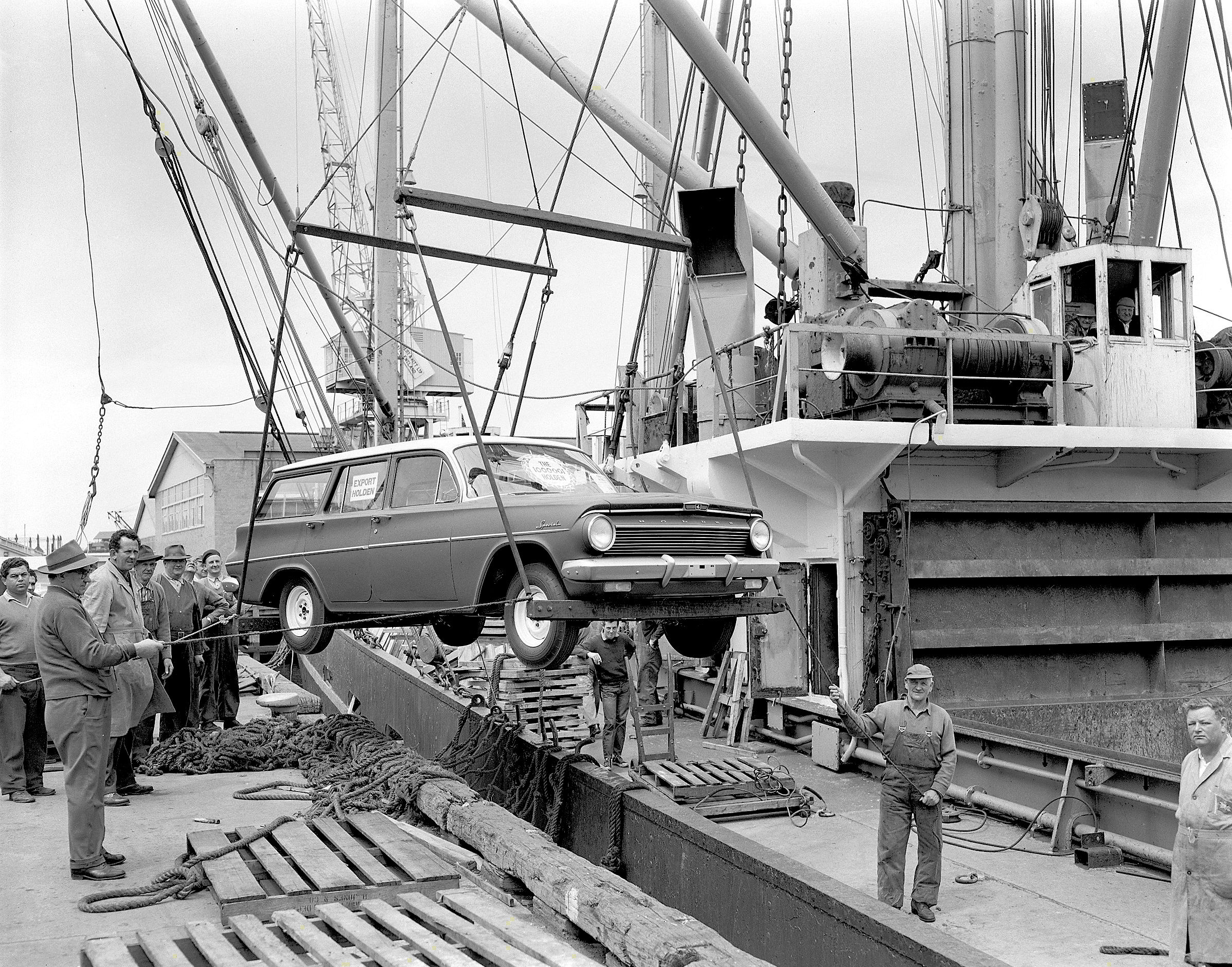
By 1967 the 100,000th export Holden vehicle was produced at Holden’s Pagewood NSW plant, and CKD Holden packs were being assembled at plants in New Zealand, South Africa, Indonesia, Trinidad, the Philippines and Pakistan. By 1969, Holden had 71 Export markets, with CKD Assembly in seven countries. This did not include shipments to New Guinea, New Britain, New Ireland and the Solomon Islands which were considered to be domestic territories.
In 1983, GM-H became Australia’s foremost exporter of manufactured goods with export sales of more than $189 million. Exports of vehicles, engines, components and accessories accounted for 15.7 per cent of total sales. 149,172 Family II four-cylinder engines shipped to West Germany, the UK, South Africa and New Zealand.
From 1986 to 1990, Engine exports dominated with 209,846 Family II four-cylinder engines exported in 1987. More than 100,000 of these were shipped to Daewoo Motor (South Korea). The one millionth Holden Family II four-cylinder export engine was produced in 1988.
The VL Commodore (17,042 units) and all-new VN Commodore (15,114 units) model ranges lifted vehicle export sales so that in 1990 General Motors-Holden’s Automotive and Holden’s Engine Company recorded export revenue figures totalling $290 million.
However, exports to Asia were falling, due mainly to the tariffs imposed by those countries on engine size. Holden had a 2.6L engine which attracted penalty duties, making the car less competitive against vehicles which fitted below the 2.4L lower duty category limit.
In 1992, Russ Little was appointed to engineer a suitable car to meet Asian requirements, and Neil Pogson was appointed Planning Manager for Exports. Together, they determined that the Saab 2.3l Turbo was the ideal engine and developed the car in conjunction with Saab engineering. However, the program was cancelled by political forces in GM Europe who did not want Holden to use the Saab engine.
In 1994 HEC produced the two millionth Family II four-cylinder export engine. Its operations generated more than $1 million in export revenue each working day and by 1995. HEC became Holden Engine Operations (HEO) and was Australia’s largest exporter of manufactured automotive components. Vehicle exports, primarily to New Zealand, totalled 5485 units
A record high of 248,136 four-cylinder engines were exported in 1997 to a global customer base that included South Korea, the US, Japan, the UK, Indonesia, Egypt, Germany, South Africa, Taiwan, Poland and Belgium. HEO generated more than $2 million in export earnings each working day.
The new generation VT Commodore range, designed to compete in worldwide markets, was released and with its formal establishment as the GM Product Engineering Centre for the Asia Pacific region, Holden began to export engineering services.
In 1998, Holden announced an intention to return to volume vehicle exports. Shipments of left-hand drive Holden Commodores to the Middle East began in June and to Brazil in the third quarter. Shipments to Asia Pacific markets of Australian-built Vectra sedans and wagons commenced, totalling 9744 units. Total Holden export revenue was $548m.
HEO exported 151,233 Family II engines earning annual export revenue of $311 million, and delivered the Three Millionth Family II engine on 26th July 1999. In 2003, started exporting Global V6 engines from its new $400 million engine facility at Port Melbourne, capable of producing 900 engines a day or 240,000 engines a year.
The Middle East became Holden's largest export market, with the Commodore sold as the Chevrolet Lumina from 1998, and the Statesman from 1999 as the Chevrolet Caprice. Commodores were also sold as the Chevrolet Lumina in Brunei, Fiji and South Africa, and as the Chevrolet Omega in Brazil. Pontiac in North America also imported Commodore sedans from 2008 through to 2009 as the G8. The G8's cessation was a consequence of GM's Chapter 11 bankruptcy resulting in the demise of the Pontiac brand.
The production of the Family II engine ceased in late 2009.
Holden exports peaked in 2005 when Holden exported 60,518 vehicles in one year.
Sales of the Monaro began in 2003 to the Middle East as the Chevrolet Lumina Coupe. Later that year a modified version of the Monaro began selling in the United States (but not in Canada) as the Pontiac GTO, and under the Monaro name through Vauxhall dealerships in the United Kingdom. This arrangement continued through to 2005 when the car was discontinued. The long-wheelbase Statesman sales in the Chinese market as the Buick Royaum began in 2005, before being replaced in 2007 by the Statesman-based Buick Park Avenue. Statesman/Caprice exports to South Korea also began in 2005. These Korean models were sold as the Daewoo Statesman, and later as the Daewoo Veritas from 2008. Holden's move into international markets proved profitable; export revenue increased from A$973 million in 1999 to just under $1.3 billion in 2006.
From 2011, the WM Caprice was exported to North America as the Chevrolet Caprice PPV, a version of the Caprice built exclusively for law enforcement in North America and sold only to police. From 2007, the HSV-based Commodore was exported to the United Kingdom as the Vauxhall VXR8.
In 2013, Chevrolet announced that exports of the Commodore would resume to North America in the form of the VF Commodore as the Chevrolet SS sedan for the 2014 model year. The Chevrolet SS Sedan was also imported to the United States (but again, not to Canada) for 2015 with only minor changes, notably the addition of Magnetic Ride Control suspension and a Tremec TR-6060 manual transmission.
For the 2016 model year, the SS sedan received a facelift based on the VF Series II Commodore unveiled in September 2015.
In 2017, production of Holden's last two American exports, the SS and the Caprice PPV was discontinued.
1969 List of 71 Holden Export Countries
This page is divided into four sections (use the links below):
| Year | Description | Link |
| 1956 | Holden Export brochure | |
| 1965-1969 | Highlights of Holden Exports | |
| 2004 | Holden Export Heritage |
| Year | Description | Link |
| 1912 | Buick and GM Export Extract | |
| 1923 | General Motors Export 1920s Advertisements | |
| 1927 Feb | GMW Export action | |
| 1928 Feb | GMW Visits with Exporters abroad | |
| 1928 Apr | GMW Exports abroad | |
| 1928 Jun | GMW Exporters at Home and Abroad | |
| 1928 Oct | GMW Close-up of export areas | |
| 1930 Aug | GMW GM Exporter first to welcome Amy Johnson | |
| 1934 Dec 02 | Export bodies to East | |
| 1935 Jan 25 | Export bodies to East | |
| 1953 Jul 10 | GMH expansion | |
| 1954 to 2004 | Export Timeline | |
| 1959 to 2004 | Table of Export Volumes | |
| 1971 - 1972 | Product Program Submission Statesman Export to UK | |
| 1992 | Export Organisation Bulletin | |
| 1994 | The best export program that never was - The Saab 2.3l engine | |
| 1998 Sep 22 | Elizabeth Plant 3 Export Layout | |
| 1999 Sep 08 | $1Billion Export Drive Announced | |
| 1999 Sep 08 | Export Caprice | |
| 2000 | Export Caprice to Dubai | |
| 2003 Nov 16 | Advertiser Article re Elizabeth Exports | |
| 2003 | Export to Korea Announcement | |
| 2004 Nov 10 | Holden Export Timeline | |
| 2004 Nov 10 | Holden's 50 Years of Exports | |
| 2007 | Export vehicle volumes | |
| 2012 Mar 22 | Holden Export Production Information | |
| Engine Exports | ||
| 1988 Feb 25 | One Millionth FII Export Engine | |
| 1999 Jul 03 | Three Millionth FII Engine export |
Photographs:
| Year/s | Content | Link |
| 1954 | FJ New Zealand Shipment | JPG |
| 1954 | FJ Shipment in Hold | JPG |
| 1955 | Loading Export FJs | JPG |
| 1956 | First CKD Shipment to New Zealand | JPG |
| 1959 | Export FE | JPG |
| 1959 | FE Export to Thailand | JPG |
| 1959 | FE in Fiji | JPG |
| 1959 | FE in Fiji( 2) | JPG |
| 1959 | FE in Thailand | JPG |
| 1960 | FB Holdens in Indonesia | JPG |
| 1961 | EK Holden in New Guinea | JPG |
| 1962 | EK Holden in Hong Kong | JPG |
| 1962 | EK Holden in South Africa | JPG |
| 1962 | EJ Wagon Export to New Zealand | JPG |
| 1965 | EH Holden in the Philippines | JPG |
| 1965 | EH in the street in Hong Kong | JPG |
| 1965 | HD in Nairobi National Park | JPG |
| 1966 | Torque Converters export to UK | JPG |
| 1967 | 100,000th Export HR to Thailand | JPG |
| 1968 | CKD Packs to South Africa | JPG |
| 1968 | HD Export shipment | JPG |
| 1968 | HD Middle East shipment | JPG |
| 1968 | HD Shipment to Greece | JPG |
| 1968 | HDs Pre-shipment in South Australia | JPG |
| 1969 | HT Export Assembly line | JPG |
| 1969 | Torana Export Assembly line | JPG |
| 1970 | CKD Packs at Acacia Ridge | JPG |
| 1970 | First Trimatics exported to Argentina | JPG |
| 1970 | HG model CKD Pack | JPG |
| 1970 | Torana shipment at South Australia | JPG |
| 1971 | HQ Holden export shipment | JPG |
| 1972 | HQ Export El Camino | JPG |
| 1972 | HQ Export Taxis to Zambia | JPG |
| 1974 | HJ Export Sedan | JPG |
| 1974 | HJ Export Utes | JPG |
| 1979 | Export VB Commodores | JPG |
| 1979 | Export VB Commodores (2) | JPG |
| 1979 | Export VB Commodores | JPG |
| 1979 | VB Commodores for export | JPG |
| 1989 | Export VN Commodores | JPG |
| 1992 | VN Export to Thailand | JPG |
| 1998 | Chevrolet Dealership, Middle East | JPG |
| 1998 | Chevrolet Lumina SS (VT) | JPG |
| 1998 | Export VT in the Middle East (2) | JPG |
| 1998 | Export VT in the Middle East | JPG |
| 1999 | Caprice, Saudi Police Fleet | JPG |
| 1999 | Caprice, Saudi Police Feet (2) | JPG |
| 1999 | Export Assembly Line, South Australia | JPG |
| 1999 | Export VT in Brazil | JPG |
| 2000 | Chevrolet Caprice, Dubai | JPG |
| 2000 | WH Caprice SS, Middle East | JPG |
| 2000 | WH Caprice, Dubai | JPG |
| 2001 | VX SS in South Africa | JPG |
| 2002 | Monaro for export to the Middle East | JPG |
| 2003 | Chevrolet Lumina Coupe loading at South Australia | JPG |
| 2003 | Chevrolet Lumina, Malaysia | JPG |
| 2003 | Chevrolet Lumina, Thailand | JPG |
| 2003 | Chevrolet SS Coupe | JPG |
| 2003 | GTO on the assembly line, Elizabeth South Australia | JPG |
| 2003 | GTO on the assembly line, Elizabeth, SA | JPG |
| 2003 | Loading first US Pontiac GTO | JPG |
| 2003 | MD Peter Hanenberger with the first US GTO shipment | JPG |
| 2004 | Chevrolet Lumina SS in the Middle East | JPG |
| 2004 | Chevrolet Lumina SS in the Middle East (2) | JPG |
| 2004 | Chevrolet Lumina SS in the Middle East (3) | JPG |
| 2004 | Vauxhall Monaro in London, UK | JPG |
| 2004 | Vauxhall Monaro in London | JPG |
| 2004 | WL Chevrolet Caprice Royale in the Middle East | JPG |
| 2004 | WL Chevrolet Caprice Royale in the Middle East (2) | JPG |
| 2004 | WL Chevrolet Caprice Royale in the Middle East (3) | JPG |
| 2004 | WL Chevrolet Caprice Royale in the Middle East (4) | JPG |
| 2005 | Pontiac GTO | JPG |
| 2005 | Pontiac GTO (2) | JPG |
| Engine exports | ||
| 1981 | Opening of the 4-cylinder engine plant, Port Melbourne | JPG |
| c1986 | Four-cylinder engine plant, Port Melbourne | JPG |
| c1986 | Four-cylinder engine plant, Port Melbourne (2) | JPG |
| 1988 | One millionth export engine shipped. | JPG |
| 1988 | Packing Family II Export engine | JPG |
| 1999 | Three Millionth Export engine shipped | JPG |
| 2004 | Global V6 Engine Assembly | JPG |
| 2004 | Global V6 Engine Assembly (2) | JPG |